नई बेसिक सैलरी कैसे कैलकुलेट करें? हिमाचल प्रदेश सरकारी कर्मचारियों के लिए नया पे मैट्रिक्स टेबल!
The Himachal Pradesh State Government Pay Matrix introduced under the 7th Pay Commission establishes a structured, level-based salary framework for state government employees. It replaces the earlier grade pay system, ensuring greater clarity, uniformity, and transparency in pay fixation, annual increments, and career progression.
This pay matrix acts as an essential reference for a wide range of Himachal Pradesh government staff, including teachers, clerical employees, police personnel, healthcare workers, and administrative officials, helping standardize compensation across various service categories.
8th Central Pay Commission Questionnaire 2026 – Submit Your Views/Suggestions
The Government of India has constituted the 8th Central Pay Commission to review pay structure, allowances, pension, and service conditions for Central Government employees.
The Commission has released a detailed Questionnaire seeking inputs/views from all stakeholders (including State Governments, institutions, and individuals). Odisha Finance Department has circulated the Questionnaire and requested all departments to widely disseminate it and encourage submissions.
Q1. Implementation of the recommendations of a Pay Commission has macro economics impacts. Some of these are positive in terms of boost to consumption and savings whilst others are negative in terms of the higher fiscal deficit, inflationary potential & crowding out of other expenditure such as for overall development & public welfare. Decisions in this regard involve choices. Based on current state of the economy & the country’s aspirations, what should be the guiding philosophy which must underpin the overall approach of the 8 CPC?Economics
Q2. Pay determination in organisations including Government involves “horizontal relativity” i.e. for analogous posts across domains/cadres being placed in the same level/scale & “vertical relativity” i.e. on promotion, transition to a higher scale/band of pay. Relativity within different posts of Government has been broadly established over time. However, relativity/positioning between pay and perquisites in Government and the private sector is less established. How should the 8th CPC assess/evaluate relativity between pay & perquisites in Government and the public/private sector?
Q3. Should 8th CPC consider uniform horizontal relativity across all government departments, or should it consider sector-specific benchmarking where government functions are compared with their respective industry peers? For instance, should compensation for government engineers be benchmarked against private sector engineering firms, financial officers against the BFSI sector, and healthcare professionals against private healthcare? What would be the advantages and implementation considerations of such an approach?
Q4. Security of tenure, a training regimen, housing, leave encashment, predictable increments, medical coverage, time bound progression, inflation indexed salary, retiral benefits are certain features associated with most jobs in Government. How should these be factored in while crafting a compensation matrix and relative positioning viz-a-vis the private sector?
Q5. Government employment is part of the organized sector. A far larger proportion of the job force is in the informal sector and the gig economy. What influence do you think entry level pay scales implemented by Government have on compensation practices in the informal or gig sector?
Q6. Salaries in Government have a distinct element of compensation for length of service (increment, usually annual), an element of neutralization for changes in cost of living/inflation (dearness allowance) & an element for higher responsibilities based on seniority/merit (pay scale on promotion). In that context, what do you think the “fitment factor” adopted by Pay Commissions should represent? What should such a fitment factor principally aim for?
Q7. Salary of a Secretary in the Central Government typically represents the apex or the pinnacle i.e. the highest end of the scale. What should be the principle for determining this? Should there be a variable pay component for such position?
Q8. How can pay scales for all Group A Services be fixed so as to attract candidates of the requisite caliber? Should pay scales be more attractive at entry point or later, after a few years in service? What principles should guide such differentiation to ensure competitive positioning for talent-critical roles while maintaining fiscal prudence?
Q9. How should rates and frequency of increments in respect of different scales of pay be determined? Should these be uniform or vary across scales/ time periods during service?
Q10. Over course of time, many allowances have been introduced or rationalized based on specific nature of work, expenses such as on travel, compensation for hardship/risk/peculiarities associated with place of posting etc. Most of these are partially inflation indexed. An alternative approach has been the Cafeteria Approach followed by Central Public Sector Enterprises (CPSEs), wherein except for a handful of allowances, executives choose from a set of perquisites & allowances, subject to an overall ceiling of basic pay. Which approach do you think is more appropriate for Central Government employees?
Q11. The Seventh Pay Commission had assessed that in January, 2014, there were about 47 lakh serving Central Government personnel. This included CAPF, Railways & Defence forces. The number of pensioners was just short of 52 lakh. In 2025-26, the number of Central Government personnel stands at about 50 lakh, which the number of pensioners is almost 70 lakh. The increase in the number of pensions has created additional demands on Government’s Budget. What approaches could help to satisfy reasonable expectations of pensioners whilst keeping the fiscal impact within manageable limits?
Q12. The Seventh Pay Commission was constituted in 2014 and implemented from 1.1.2016. The period since then has been marked by a lower trajectory of inflation, as compared to earlier decades. This is also reflected in the All India Consumer Price Index (Industrial Workers) which is used for DA calculation. Should the 8th CPC explore a hybrid indexation approach that factors in both inflation protection and formal sector wage growth trends? What proportion might be reasonable for each component, and what implementation considerations would arise? What are your expectations on inflation/CPI increase over the next 10 years?
Q13. Railways, CAPF and Defence forces typically account for about 70% of Central Government personnel. What particular considerations, monetary or non monetary should be factored in while determining their pay & allowances?
Q14. Scientists work in certain specialized streams/departments such as Department of Space, Department of Atomic Energy etc. What should be appropriate benchmarks to be kept in mind for fixing their emoluments?
Q15. Military Service Pay is currently admissible to personnel of Armed Forces. This was in recognition of the special nature of their duties. In that context and given the changing nature of their jobs, how should the pay of soldiers, sailors and airforce personnel be determined? How should it relate to the starting salary in Government or the pay of a constable in CAPF/ Police?
Q16. The nation has many more military pensioners than serving military personnel. In 2025-26, outgo on Defence Pensions is likely to be higher than the outgo on Defence salary and allowances. As overall defence pension bill increases, in line with projections, impact will be visible on equipment and arms purchase, their maintenance and on modernization of defence forces. What changes would you recommend to contain increases in defence manpower costs and its pension bill?
Q17. Productivity Linked Bonus (PLB) is paid to some employees of Government such as Railways, Postal staff whilst Non-Productivity Linked Bonus is given to specified Central Government employees including some in Armed Forces. How can the Bonus structure be reimagined for rewarding excellence in productivity & performance? Should PLB/ Ad-hoc Bonus continue to be given on uniform basis (e.g. 60 days of salary for all) or be differentiated, based on individual performance?
Q18. Contractual appointments in the form of lateral entry have been tried during the last few years. Do you think this should be expanded and other practices such as part-time work, flexi time etc. be introduced in Government at middle/ higher levels to tap a bigger talent pool? What could be the pros and cons of doing so?
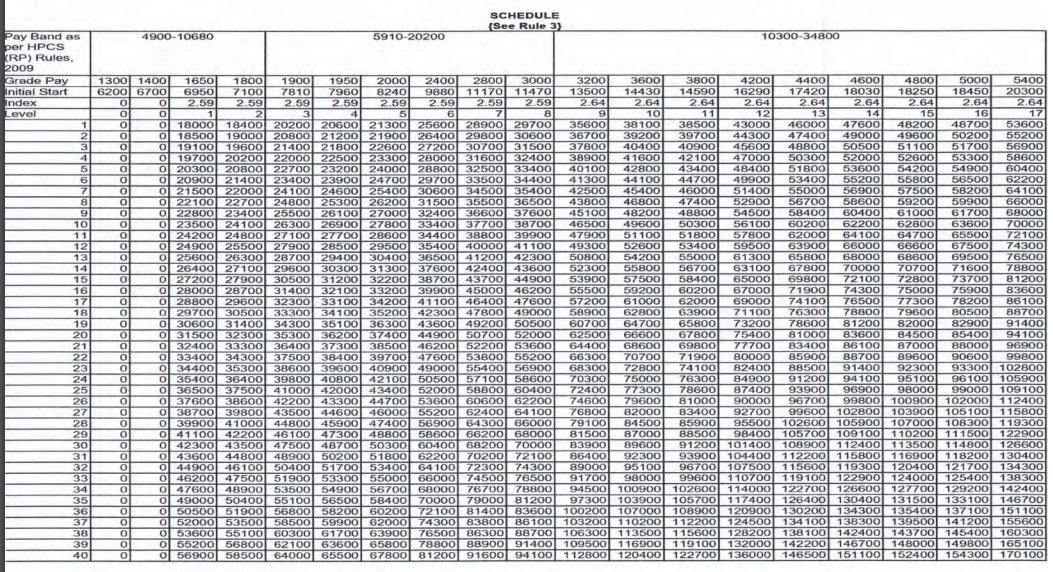
Pay Matrix Table for HP Govt Employees
Pay Band–1 (₹4900 – ₹10,680)
| Level | GP 1300 (Initial 6200) |
GP 1400 (Initial 6700) |
GP 1650 (Initial 6950) |
GP 1800 (Initial 7100) |
|---|---|---|---|---|
| 1 | 0 | 0 | 18000 | 18400 |
| 2 | 0 | 0 | 18500 | 19000 |
| 3 | 0 | 0 | 19100 | 19600 |
| 4 | 0 | 0 | 19700 | 20200 |
| 5 | 0 | 0 | 20300 | 20800 |
| 6 | 0 | 0 | 20900 | 21400 |
| 7 | 0 | 0 | 21500 | 22000 |
| 8 | 0 | 0 | 22100 | 22700 |
| 9 | 0 | 0 | 22800 | 23400 |
| 10 | 0 | 0 | 23500 | 24100 |
| 11 | 0 | 0 | 24200 | 24800 |
| 12 | 0 | 0 | 24900 | 25500 |
| 13 | 0 | 0 | 25600 | 26300 |
| 14 | 0 | 0 | 26400 | 27100 |
| 15 | 0 | 0 | 27200 | 27900 |
| 16 | 0 | 0 | 28000 | 28700 |
| 17 | 0 | 0 | 28800 | 29600 |
| 18 | 0 | 0 | 29700 | 30500 |
| 19 | 0 | 0 | 30600 | 31400 |
| 20 | 0 | 0 | 31500 | 32300 |
| 21 | 0 | 0 | 32400 | 33300 |
| 22 | 0 | 0 | 33400 | 34300 |
| 23 | 0 | 0 | 34400 | 35300 |
| 24 | 0 | 0 | 35400 | 36400 |
| 25 | 0 | 0 | 36500 | 37500 |
| 26 | 0 | 0 | 37600 | 38600 |
| 27 | 0 | 0 | 38700 | 39800 |
| 28 | 0 | 0 | 39900 | 41000 |
| 29 | 0 | 0 | 41100 | 42200 |
| 30 | 0 | 0 | 42300 | 43500 |
| 31 | 0 | 0 | 43600 | 44800 |
| 32 | 0 | 0 | 44900 | 46100 |
| 33 | 0 | 0 | 46200 | 47500 |
| 34 | 0 | 0 | 47600 | 48900 |
| 35 | 0 | 0 | 49000 | 50400 |
| 36 | 0 | 0 | 50500 | 51900 |
| 37 | 0 | 0 | 52000 | 53500 |
| 38 | 0 | 0 | 53600 | 55100 |
| 39 | 0 | 0 | 55200 | 56800 |
| 40 | 0 | 0 | 56900 | 58500 |
Pay Band–2 (₹5910 – ₹20,200)
| Level | GP 1900 (Initial 7810) |
GP 1950 (Initial 7960) |
GP 2000 (Initial 8240) |
GP 2400 (Initial 9880) |
GP 2800 (Initial 11170) |
GP 3000 (Initial 11470) |
|---|---|---|---|---|---|---|
| 1 | 20200 | 20600 | 21300 | 25600 | 28900 | 29700 |
| 2 | 20800 | 21200 | 21900 | 26400 | 29800 | 30600 |
| 3 | 21400 | 21800 | 22600 | 27200 | 30700 | 31500 |
| 4 | 22000 | 22500 | 23300 | 28000 | 31600 | 32400 |
| 5 | 22700 | 23200 | 24000 | 28800 | 32500 | 33400 |
| 6 | 23400 | 23900 | 24700 | 29700 | 33500 | 34400 |
| 7 | 24100 | 24600 | 25400 | 30600 | 34500 | 35400 |
| 8 | 24800 | 25300 | 26200 | 31500 | 35500 | 36500 |
| 9 | 25500 | 26100 | 27000 | 32400 | 36600 | 37600 |
| 10 | 26300 | 26900 | 27800 | 33400 | 37700 | 38700 |
| 11 | 27100 | 27700 | 28600 | 34400 | 38800 | 39900 |
| 12 | 27900 | 28500 | 29500 | 35400 | 40000 | 41100 |
| 13 | 28700 | 29400 | 30400 | 36500 | 41200 | 42300 |
| 14 | 29600 | 30300 | 31300 | 37600 | 42400 | 43600 |
| 15 | 30500 | 31200 | 32200 | 38700 | 43700 | 44900 |
| 16 | 31400 | 32100 | 33200 | 39900 | 45000 | 46200 |
| 17 | 32300 | 33100 | 34200 | 41100 | 46400 | 47600 |
| 18 | 33300 | 34100 | 35200 | 42300 | 47800 | 49000 |
| 19 | 34300 | 35100 | 36300 | 43600 | 49200 | 50500 |
| 20 | 35300 | 36200 | 37400 | 44900 | 50700 | 52000 |
| 21 | 36400 | 37300 | 38500 | 46200 | 52200 | 53600 |
| 22 | 37500 | 38400 | 39700 | 47600 | 53800 | 55200 |
| 23 | 38600 | 39600 | 40900 | 49000 | 55400 | 56900 |
| 24 | 39800 | 40800 | 42100 | 50500 | 57100 | 58600 |
| 25 | 41000 | 42000 | 43400 | 52000 | 58800 | 60400 |
| 26 | 42200 | 43300 | 44700 | 53600 | 60600 | 62200 |
| 27 | 43500 | 44600 | 46000 | 55200 | 62400 | 64100 |
| 28 | 44800 | 45900 | 47400 | 56900 | 64300 | 66000 |
| 29 | 46100 | 47300 | 48800 | 58600 | 66200 | 68000 |
| 30 | 47500 | 48700 | 50300 | 60400 | 68200 | 70000 |
| 31 | 48900 | 50200 | 51800 | 62200 | 70200 | 72100 |
| 32 | 50400 | 51700 | 53400 | 64100 | 72300 | 74300 |
| 33 | 51900 | 53300 | 55000 | 66000 | 74500 | 76500 |
| 34 | 53500 | 54900 | 56700 | 68000 | 76700 | 78800 |
| 35 | 55100 | 56500 | 58400 | 70000 | 79000 | 81200 |
| 36 | 56800 | 58200 | 60200 | 72100 | 81400 | 83600 |
| 37 | 58500 | 59900 | 62000 | 74300 | 83800 | 86100 |
| 38 | 60300 | 61700 | 63900 | 76500 | 86300 | 88700 |
| 39 | 62100 | 63600 | 65800 | 78800 | 88900 | 91400 |
| 40 | 64000 | 65500 | 67800 | 81200 | 91600 | 94100 |
Pay Band–3 (₹10,300 – ₹34,800)
| Level | GP 3200 (Initial 13500) |
GP 3600 (Initial 14500) |
GP 3800 (Initial 15300) |
GP 4200 (Initial 16600) |
GP 4400 (Initial 17400) |
|---|---|---|---|---|---|
| 1 | 28900 | 30300 | 31800 | 34000 | 34800 |
| 2 | 29800 | 31200 | 32700 | 35000 | 35800 |
| 3 | 30700 | 32100 | 33600 | 36000 | 36900 |
| 4 | 31600 | 33000 | 34600 | 37100 | 38000 |
| 5 | 32500 | 34000 | 35600 | 38200 | 39200 |
| 6 | 33500 | 35000 | 36600 | 39400 | 40400 |
| 7 | 34500 | 36000 | 37700 | 40600 | 41600 |
| 8 | 35500 | 37100 | 38800 | 41800 | 42900 |
| 9 | 36600 | 38200 | 39900 | 43100 | 44200 |
| 10 | 37700 | 39300 | 41100 | 44400 | 45600 |
| 11 | 38800 | 40500 | 42300 | 45800 | 47000 |
| 12 | 40000 | 41700 | 43500 | 47200 | 48400 |
| 13 | 41200 | 42900 | 44800 | 48600 | 49900 |
| 14 | 42400 | 44200 | 46100 | 50100 | 51400 |
| 15 | 43700 | 45500 | 47400 | 51600 | 52900 |
| 16 | 45000 | 46800 | 48800 | 53200 | 54500 |
| 17 | 46400 | 48200 | 50200 | 54800 | 56100 |
| 18 | 47800 | 49700 | 51700 | 56400 | 57800 |
| 19 | 49200 | 51200 | 53200 | 58100 | 59500 |
| 20 | 50700 | 52700 | 54800 | 59800 | 61300 |
| 21 | 52200 | 54300 | 56400 | 61600 | 63100 |
| 22 | 53800 | 55900 | 58000 | 63400 | 64900 |
| 23 | 55400 | 57500 | 59700 | 65200 | 66800 |
| 24 | 57100 | 59200 | 61500 | 67100 | 68700 |
| 25 | 58800 | 60900 | 63200 | 69000 | 70700 |
| 26 | 60600 | 62700 | 65100 | 71000 | 72700 |
| 27 | 62400 | 64500 | 66900 | 73000 | 74700 |
| 28 | 64300 | 66400 | 68800 | 75100 | 76800 |
| 29 | 66200 | 68300 | 70800 | 77200 | 78900 |
| 30 | 68200 | 70300 | 72800 | 79400 | 81100 |
| 31 | 70200 | 72300 | 74800 | 81600 | 83300 |
| 32 | 72300 | 74400 | 76900 | 83900 | 85600 |
| 33 | 74500 | 76600 | 79100 | 86200 | 88000 |
| 34 | 76700 | 78800 | 81300 | 88600 | 90400 |
| 35 | 79000 | 81100 | 83600 | 91000 | 92900 |
| 36 | 81400 | 83500 | 86000 | 93500 | 95400 |
| 37 | 83800 | 85900 | 88400 | 96000 | 98000 |
| 38 | 86300 | 88400 | 90900 | 98600 | 100700 |
| 39 | 88900 | 91000 | 93500 | 101200 | 103400 |
| 40 | 91600 | 93700 | 96100 | 103900 | 106200 |
Pay Band–3 (₹10,300 – ₹34,800)
| Level | GP 4600 (Initial 18000) |
GP 4800 (Initial 19100) |
GP 5000 (Initial 20600) |
GP 5400 (Initial 22000) |
|---|---|---|---|---|
| 1 | 35700 | 37500 | 39200 | 41300 |
| 2 | 36700 | 38600 | 40300 | 42500 |
| 3 | 37800 | 39700 | 41400 | 43700 |
| 4 | 38900 | 40900 | 42600 | 45000 |
| 5 | 40100 | 42100 | 43900 | 46300 |
| 6 | 41300 | 43400 | 45200 | 47700 |
| 7 | 42500 | 44700 | 46500 | 49100 |
| 8 | 43800 | 46000 | 47900 | 50500 |
| 9 | 45100 | 47400 | 49300 | 52000 |
| 10 | 46500 | 48800 | 50800 | 53600 |
| 11 | 47900 | 50300 | 52300 | 55200 |
| 12 | 49400 | 51800 | 53900 | 56800 |
| 13 | 50900 | 53300 | 55500 | 58500 |
| 14 | 52400 | 54900 | 57200 | 60200 |
| 15 | 54000 | 56500 | 58900 | 62000 |
| 16 | 55600 | 58200 | 60600 | 63800 |
| 17 | 57300 | 59900 | 62400 | 65700 |
| 18 | 59000 | 61700 | 64200 | 67600 |
| 19 | 60700 | 63500 | 66100 | 69600 |
| 20 | 62500 | 65300 | 68000 | 71600 |
| 21 | 64300 | 67200 | 70000 | 73700 |
| 22 | 66200 | 69100 | 72000 | 75800 |
| 23 | 68200 | 71100 | 74100 | 78000 |
| 24 | 70200 | 73200 | 76200 | 80200 |
| 25 | 72300 | 75300 | 78400 | 82500 |
| 26 | 74400 | 77500 | 80600 | 84800 |
| 27 | 76600 | 79700 | 82900 | 87200 |
| 28 | 78800 | 82000 | 85200 | 89600 |
| 29 | 81100 | 84400 | 87600 | 92100 |
| 30 | 83500 | 86800 | 90000 | 94700 |
| 31 | 85900 | 89300 | 92500 | 97300 |
| 32 | 88400 | 91800 | 95100 | 100000 |
| 33 | 91000 | 94400 | 97700 | 102900 |
| 34 | 93600 | 97100 | 100400 | 105800 |
| 35 | 96300 | 99800 | 103100 | 108800 |
| 36 | 99000 | 102600 | 105900 | 111900 |
| 37 | 101800 | 105400 | 108700 | 115000 |
| 38 | 104700 | 108300 | 111600 | 118200 |
| 39 | 107600 | 111200 | 114600 | 121500 |
| 40 | 110600 | 114200 | 117600 | 124800 |
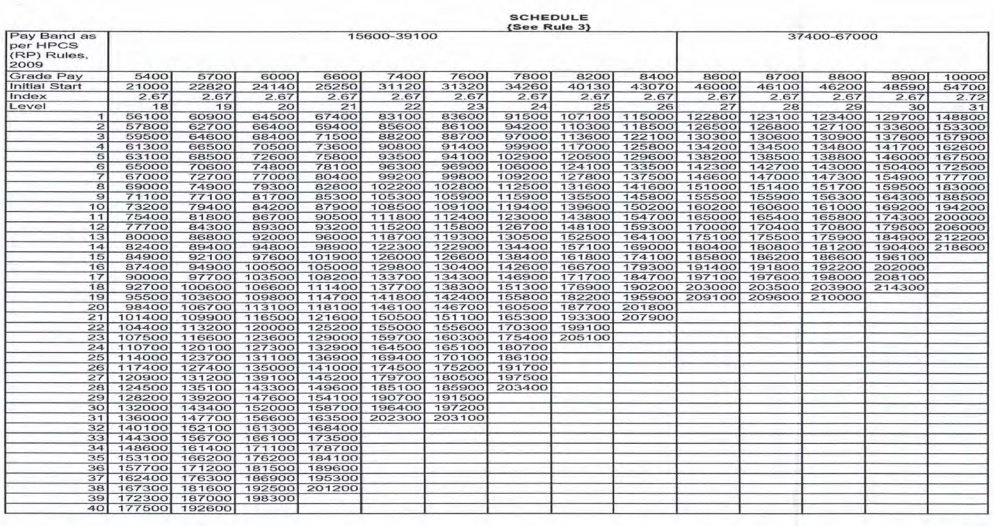
Pay Band–4 (₹15,600 – ₹39,100)
| Level | GP 5400 (Initial 21000) |
GP 5700 (Initial 22820) |
GP 6000 (Initial 24140) |
GP 6600 (Initial 25250) |
GP 7400 (Initial 31120) |
GP 7600 (Initial 31320) |
GP 7800 (Initial 34260) |
GP 8200 (Initial 40130) |
GP 8400 (Initial 43070) |
|---|---|---|---|---|---|---|---|---|---|
| 18 | 56100 | 60900 | 64500 | 67400 | 83100 | 83600 | 91500 | 107100 | 115000 |
| 19 | 57800 | 62700 | 66400 | 69400 | 85600 | 86100 | 94200 | 110300 | 118500 |
| 20 | 59500 | 64600 | 68400 | 71500 | 88200 | 88700 | 97000 | 113600 | 122100 |
| 21 | 61300 | 66500 | 70500 | 73600 | 90800 | 91400 | 99900 | 117000 | 125800 |
| 22 | 63100 | 68500 | 72600 | 75800 | 93500 | 94100 | 102900 | 120500 | 129600 |
| 23 | 65000 | 70600 | 74800 | 78100 | 96300 | 96900 | 106000 | 124100 | 133500 |
| 24 | 67000 | 72700 | 77000 | 80400 | 99200 | 99800 | 109200 | 127800 | 137500 |
| 25 | 69000 | 74900 | 79300 | 82800 | 102200 | 102800 | 112500 | 131600 | 141600 |
| 26 | 71100 | 77100 | 81700 | 85300 | 105300 | 105900 | 115900 | 135500 | 145800 |
Pay Calculator for Himachal Pradesh State Government Employees
Notional Increment for Pension – Employees Retiring 1 Day Before Annual Increment | Finance Dept Odisha OM No.7165 Dated 18.03.2026
All State Government employees retiring one day prior to annual increment date
The Government modifies para-5 of earlier Finance Department OM No.2392 dated 22.01.2025 (which granted notional increment for pension to employees retiring one day before increment date).
The benefit of notional increment is now payable only from 30.07.2021 (date of Hon’ble High Court of Odisha judgment in Arun Kumar Biswal case). No arrears/enhanced pension shall be paid prior to 30.07.2021.